
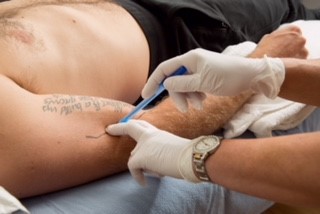
Dry needling and acupuncture both involve the insertion of thin needles into the body. Both are used by regulated Canadian health professionals to treat musculoskeletal pain and improve function. But that is roughly where the similarities end.
For clinicians trained in both modalities, knowing when to reach for each one is a clinical skill in its own right. The choice is not about preference. It is about matching the right technique to what the patient’s body actually needs. And for practitioners working in Canada, that choice is available in ways it simply is not in many other countries.
The Canadian Difference: Why DN and Acupuncture Coexist Here
In many parts of the world, dry needling and acupuncture are treated as competing practices. In the United States especially, the two camps rarely converge. Those who practice dry needling often argue it developed entirely independently of acupuncture, tracing its origins to work done in the 1940s. Those trained in acupuncture maintain that traditional practice already encompasses needle insertion techniques of this kind. The debate has been contentious, and it has had real consequences for how practitioners are trained and what they are permitted to do.
Canadian clinicians have largely been spared this conflict.
The reason comes down to history. Physiotherapists in Canada have long been trained in neuroanatomical acupuncture, a system developed by Dr. Joseph Wong that gave Canadian practitioners a rigorous foundation in both approaches. That foundation means clinicians here can hold both tools at once and use them together in ways that practitioners working in more divided professional environments simply cannot access.
That freedom is not just a regulatory convenience. It opens up treatment possibilities that change what patients experience and what clinicians can offer. Understanding how to use each modality well, and how to combine them, is what separates competent needling practice from genuinely excellent clinical care.
What Dry Needling Does Best
Dry needling is defined as the insertion of a filiform needle into tender points in the body without the injection of any substance. In practice, it is used most effectively for musculoskeletal issues, particularly those involving myofascial pain and trigger points.
A trigger point is a tight, tender band of muscle that refers pain to another area of the body. When a muscle develops trigger points, it typically becomes stiff and weak. Patients often present with a referred pain pattern they cannot explain because the source and the symptom are in different locations. They point to where it hurts. The problem is somewhere else entirely.
A dry needling session targets those points directly. The response is often fast. Patients experience relief from the referred pain, and strength and range of motion can improve almost immediately after treatment. For patients working within limited health benefits who need results quickly, that speed matters. It is one of the strongest clinical arguments for having dry needling in your toolkit.
What Dry Needling Cannot Do Alone
It is equally important to be clear about where dry needling reaches its limits. Nerve issues do not respond well to a dry needling technique on its own. Neither does widespread inflammation, severe acute pain, or tendonitis. When a patient presents with significant acute swelling and pain, dry needling is not the right first tool. Applying it in those situations is unlikely to help and may increase the patient’s discomfort.
The modality works on specific mechanical problems in muscle tissue. It is precise and targeted by design. That precision is its strength. But precision also means it is not built for systemic or widespread presentations, and trying to use it that way produces poor results.
Where Acupuncture Takes Over
Acupuncture works differently. Rather than targeting a specific trigger point in an isolated muscle, it works on the broader system. It addresses nerve pathways, inflammation, pain management, and chronic conditions through acupuncture points along the body. The reach is wider. The mechanism is different.
For nerve-related issues in particular, acupuncture treatment is the stronger option. It can treat a nerve both at the site of the problem and further along its path. This makes it especially effective for conditions that have a systemic dimension, where the problem is not confined to one tight muscle but distributed across the body’s signalling network.
Chronic pain conditions tend to need this kind of deeper, more widespread treatment. They require work on energy and meridian points that dry needling does not reach. The chronicity itself changes what the body needs. A patient with a long-standing condition is not simply a patient with a very persistent trigger point. The problem has become embedded in the system, and the treatment needs to reflect that.
When Patients Cannot Tolerate Dry Needling
Not every patient will accept dry needling. The technique can be uncomfortable, and for some patients the sensation is simply too much. This is not a failure of the treatment or the patient. It is a clinical reality that every practitioner using needles will encounter.
For those patients, acupuncture needles applied to the same muscle, nerve, and tendon points can still produce good results. As one clinician who uses both modalities in her daily practice puts it:
“Acupuncture will not reduce a trigger point, but it can still do everything else and is more comfortable.”
That is a meaningful clinical option to have available. The outcome may take longer to achieve, but the patient stays in treatment and continues to progress.
Acupuncture is also the better choice when a patient presents with very acute swelling and pain. In those presentations, the body needs systemic support before localized mechanical intervention. Acupuncture can provide that.
Using Both in the Same Treatment
The most effective treatments often combine both modalities in a single session. This is where Canadian clinicians, trained in both approaches, have a genuine advantage over practitioners who must choose one or the other.
Consider a patient with a chronic musculoskeletal issue like tendonopathy in the shoulder. Over time, the chronicity leads to muscle tightness, shortening, and stiffness, which produces trigger points in the surrounding musculature. The tendon itself needs support. The referred pain pattern needs to be addressed. And the systemic dimension of a chronic condition needs treatment that works beyond the local site.
In this scenario, dry needling targets the trigger points that have developed because of the chronic load. Then acupuncture addresses the local and referred pain and supports the tendon itself. Each modality handles what it does best. Together, they cover what either tool would miss on its own.
This kind of combined approach is not unusual for clinicians working at this level. It reflects a clear clinical logic: assess what the patient’s body needs, then use the right tool for each layer of the problem. Dry needling for the stiff, weak muscle causing muscle tension and referred pain. Acupuncture for the nerve pathways, systemic pain, and deeper chronic patterns.
Needling Is a Modality, Not a Solution
One point that experienced practitioners consistently return to is that needling, in any form, is a modality. It is not the whole treatment. Manual therapy, education, and corrective exercise remain essential parts of the clinical picture.
The muscle strain or imbalance that produced the trigger point in the first place needs to be corrected. The movement patterns that loaded the tendon beyond its capacity need to be addressed. Needling relieves the immediate problem and creates the conditions for recovery. It does not replace the work of resolving the underlying cause. Practitioners who treat it as the whole answer will find their results plateau. Those who use it as one component of a complete clinical approach will see the most durable outcomes.
The Bottom Line for Clinicians
The question of when to use dry needling versus acupuncture does not have a single answer. It depends on what the patient presents with, what they can tolerate, and what the treatment needs to accomplish at each stage of their recovery.
Dry needling is precise and fast-acting. It works on specific trigger points in stiff, weak muscles and delivers rapid relief from referred pain and neck pain patterns. It is the right tool when the problem is mechanical, localized, and needs quick resolution.
Acupuncture is broader in reach. It works on nerves, chronic pain, systemic inflammation, and musculoskeletal pain in ways that dry needling cannot match. It is the right tool when the problem is widespread, chronic, nerve-related, or when the patient cannot tolerate a more direct technique.
For Canadian physical therapists and other regulated health professionals trained in both, the clinical question is not which modality to choose. It is how to use both in a way that gives each patient the most complete treatment available. That combination, grounded in Canada’s unique training history and supported by rigorous continuing education, is one of the most significant advantages practitioners here can offer.
